
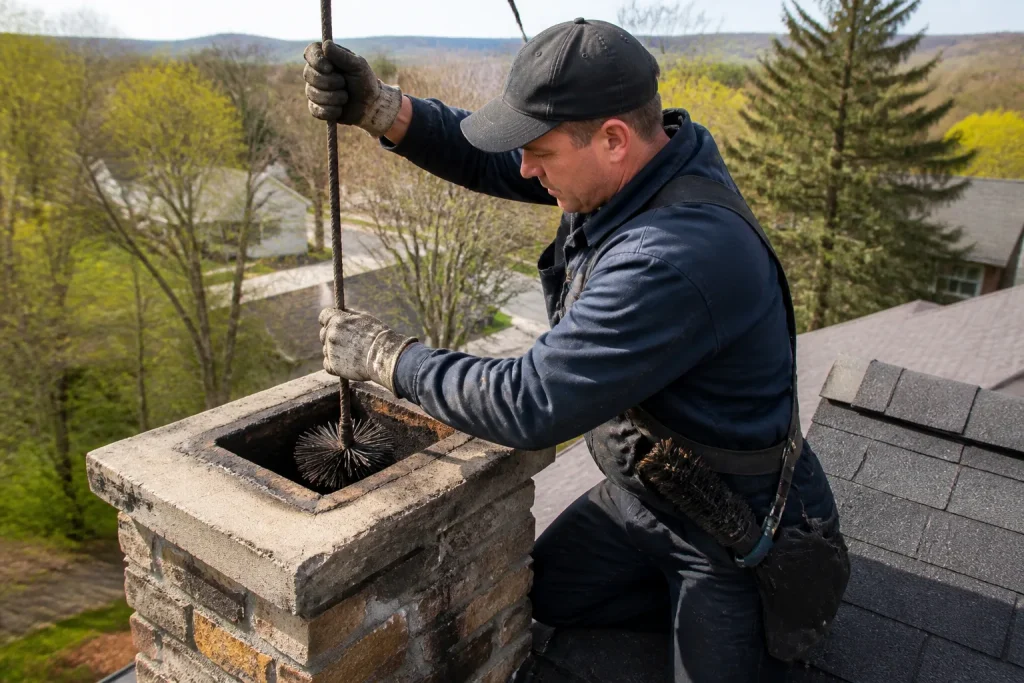
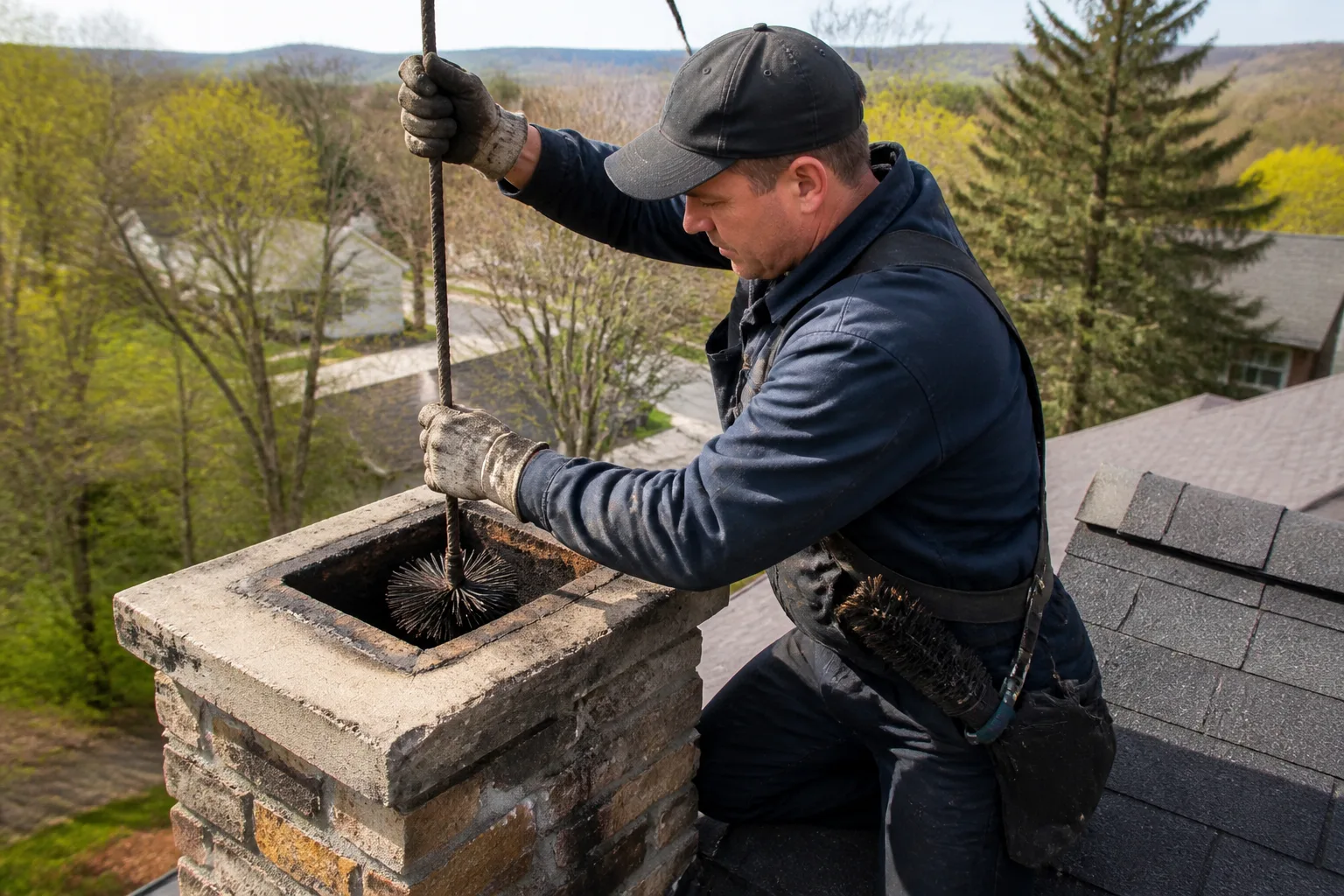
Top Signs You Need Chimney Cleaning Service – Don’t Ignore These
Most homeowners judge their chimney by what comes out of it, which is a little like judging a car by the sound of the horn. The real signals hide inside the flue, and they show up in stages. The signs below tell you not just that the chimney needs attention, but how urgent it is. If you’d rather not climb up there and guess, call (844) 542-3766. We answer 24/7, with fast dispatch from 7am to 7pm, Sunday through Friday.
One quick framing before we start. Creosote, the residue left behind when wood burns incompletely, builds up in recognizable stages. Stage 1 is a routine cleaning. Stage 3 is the glazed, tar-like coating that clings to the liner and needs chemical treatment or mechanical removal a standard sweep brush cannot touch. The signs below help you tell which stage you’re likely looking at, and when the problem stops being about cleaning at all.
What do the stages of creosote actually look and feel like from inside your house?
Stage 1 creosote looks like black soot and flakes off fairly easily. Stage 2 is denser and stickier, often with a crusty surface that a brush scrapes down but doesn’t always strip clean. Stage 3 is the hard, shiny, glazed layer that most homeowners never see because it sits deep on the flue walls.
From the living-room side, a chimney that’s holding Stage 1 usually behaves fine. You might get light soot at the firebox opening or a faint charred smell after a fire. Stage 2 shows itself in more ways: heavier soot at the damper, a smell that lingers longer, and sometimes a crusty texture if you can see any of the flue. Stage 3 is where things get serious. Glazed creosote is dense and highly combustible, and a brush won’t remove it. It’s the reason a sweep sometimes has to recommend mechanical or chemical removal before the flue can even be properly cleaned.
A Knoxville homeowner doesn’t need to diagnose the exact stage. What matters is noticing when things have moved past “routine.” The moment the residue starts behaving like tar rather than soot, it’s time to stop treating it as a cleaning job and start treating it as a real safety question.
Why does your chimney smell like oil or tar in the middle of summer?
An oily, petroleum-like smell in summer, when no fire is burning, is one of the clearest indicators of Stage 2 or Stage 3 creosote. Most people brush it off as general mustiness. It usually isn’t.
Here’s what’s happening. Warm air pulls moisture up through the cool flue, and that moisture reacts with the residue on the walls. Softer Stage 1 soot stays fairly quiet. Denser creosote releases a sharper, heavier smell that has more in common with a garage than a fireplace. The noticeability of the smell in summer, when nothing has burned in months, is the signal. If it only smells after a fire, you’re probably looking at a routine cleaning. If it smells on a hot July afternoon, there’s something heavier inside.
The same goes for a smell that seems to come from more than one room. Strong creosote odor can migrate down into the living space through the damper and open firebox, which is why homeowners sometimes notice it strongest in the room furthest from the fireplace. If the smell has an oily, tar or petroleum quality, don’t wait for fall. That’s the smell of glazed creosote, and it warrants a real look before the next burn.
What does poor fireplace draw tell you about liner condition?
A noticeably slower draw over two or three consecutive seasons points to liner or creosote accumulation, not weather. A chimney that pulled hard and then stopped pulling as well wasn’t changed by the atmosphere; something on the inside changed.
Draw performance is one of the best diagnostic tools a homeowner has, because you feel it before you see it. Look for these patterns:
- Smoke rolling back into the room when you light the first fire of the season, where it used to draft straight up.
- Fires that take longer to catch and stay smoky for the first fifteen minutes.
- Wood that used to burn with a clean flame now producing more smoke than flame, even when it’s dry.
- A damper that feels like it has to be wide open to get the same draft you used to get at half.
Any of these alone could mean a lot of things. Consistently across several burns, and across a couple of seasons, they tend to line up with a build-up on the flue walls or a liner that’s lost some integrity. A gas fireplace can also have a blocked or compromised vent, which shows up as soot at the opening or a fire that just doesn’t look right. Either way, don’t wait for it to fail.
When flaking and staining means structural trouble, not just a dirty chimney
If the staining around your firebox is coupled with flaking material, you may be looking at tile debris that’s fallen into the smoke chamber, which is a structural warning rather than a cleaning issue. This is one of the most missed signs in Knoxville homes.
Chimney tile can spall, meaning the face of the tile flakes and starts shedding pieces into the flue system. Those fragments accumulate in the smoke chamber, the sloping area above the damper and below the flue. From inside the house, you might see:
- Chalky or flaking material around the firebox opening, especially along the top edge.
- Discolored or stained masonry with a pattern that’s spreading over multiple seasons.
- Debris falling into the firebox when the damper is closed and no fire is burning.
- Rust or dark streaks on the firebox metal, which often trace back to a moisture source up top.
These point toward damage that can’t be fixed with a sweep. The smoke chamber may need resurfacing, which HeatShield is suited for because it restores the chamber without tearing the whole chimney apart. If the flue itself has lost integrity, a reline may come into the picture, which is where DuraFlex flexible liners get used. Either way, a proper inspection is what tells you which. A stand-alone inspection gives you a documented report you can act on.
Why Knoxville’s October and March burns cause the worst creosote build-up
Knoxville’s shoulder months, October and March, produce the most problematic burns because the flue is cold while the fire is being built. Cool flue, cool outside air, and an eager first fire of the season are a recipe for incomplete combustion, which is exactly what accelerates Stage 2 accumulation.
During the deep winter, the flue warms and stays warm. Draft is stronger, smoke moves up faster, and the wood burns more completely. But in October, the first fire is often a short, cool, exploratory one. The flue never fully warms. The same happens in March, when the last few fires of the season are small evening burns. Those short, cool fires leave the densest, stickiest residue, which is why chimney accumulations can look worse in spring than they did in January.
In our experience, this is the number one thing Knoxville homeowners miss. They assume a cold-season sweep covers them. In practice, the shoulder season is where the build-up accelerates. A fall inspection before the first fire and a spring check after the last one will do more for your chimney than any single sweep in mid-January.
When to call a pro
There are a handful of signs that justify picking up the phone rather than putting a note on the fridge for later. If two or more of the following describe your chimney, it’s worth having someone look:
- Persistent oily smell during the summer, not just after a fire.
- Draw that has slowly gotten worse over two or more seasons.
- Flaking or spalling tile around the firebox, or debris falling into it.
- Visible glazed, tar-like residue on any part of the flue you can see.
- Staining patterns on the masonry that are spreading.
- A chimney that hasn’t been inspected in several years and a cold-season habit that’s grown.
If you suspect glazed creosote or damage inside the flue, don’t try to handle it yourself. High-temperature creosote and compromised liner material are a serious safety matter, and trained technicians with the right tools should be the ones touching it. A pro can also work through what’s actually needed versus what can wait. Nothing gets recommended here without evidence you can review yourself.
Related services in Knoxville: if a sweep and inspection turn up something deeper, we also handle fireplace repair and chimney cap & crown so the cap-to-hearth scope lives under one roof.
How does Knoxville weather accelerate chimney problems?
Knoxville’s climate puts a specific kind of pressure on chimneys. The swings between humid summer and freezing winter, and the shoulder-season burns around them, both add to how quickly a flue accumulates residue. An exposed cap or a crown with hairline cracks gives water a place to get in, and that water does the slow kind of damage that’s easy to ignore until it isn’t.
That’s why the whole chimney matters. A chimney can be clean inside and still be getting water intrusion from above. Caps and crowns are the most common source of that water, which is why we handle them as part of the same service. From the cap down to the firebox, each piece affects the others. A south-facing chimney in Knoxville can have sun-baked cracking on the crown and water-stained masonry at the firebox at the same time, and the second one is often caused by the first.
If your chimney hasn’t been looked at in a while, the fix is straightforward: get an inspection, learn what you actually have, and put a plan together for the season ahead. Know what you have before the first fire of the season.
The Bottom Line
Chimney warning signs are usually less about what’s wrong and more about what stage you’re in. An oily summer smell, slowing draw, spalling tile around the firebox and glazed residue deep in the flue are not all the same problem, and they don’t all need the same fix. Stage 1 is a routine cleaning. Stage 3 is a real safety conversation. Shoulder-season burns in Knoxville are the fastest route to a heavier than expected accumulation, so plan a fall inspection and a spring check.
Our technicians have up to 11 years of experience, we work with professional-grade materials including HeatShield and DuraFlex, and we keep chimney inspection as a stand-alone service so the report you get is something you can actually use. If you’re in Knoxville and need help, Knoxville Chimney Sweep offers free estimates. Call (844) 542-3766. We answer 24/7, with fast dispatch from 7am to 7pm, Sunday through Friday.
Frequently Asked Questions
Most wood-burning chimneys should be swept when about an eighth of an inch of creosote has built up on the flue walls, and many Knoxville homeowners land on an annual sweep after the shoulder season. Gas fireplaces typically need less frequent sweeping but still need inspection. Call (844) 542-3766 for an exact quote, and estimates are free.
Creosote moves from Stage 1 to Stage 2 to Stage 3 over time, and the hazard and the fix both escalate as it does. The bigger risk is a chimney fire or a compromised liner that starts letting smoke or carbon monoxide into the house. Don’t ignore signs. Call (844) 542-3766 for a free estimate.
A typical Knoxville sweep and inspection is an estimate-and-approve item, and the written estimate sets the final price. We don’t quote over the phone because creosote stage and flue condition change the scope. Call (844) 542-3766, and we’ll set up the visit.
No. Glazed, tar-like creosote is too dense and hard for a standard sweep brush, and it either needs chemical treatment or mechanical removal before the flue can be properly cleaned. That’s one reason an inspection comes first. Call (844) 542-3766 to schedule a look.
Written by the team at Knoxville Chimney Sweep.
Need Chimney Cleaning Help?
Call Knoxville Chimney Sweep - the local pro we connect you with is licensed and insured, with free written estimates in Knoxville.
(844) 542-3766